Software Without Pause
Unreal, unprecedented speed of releases and updates
Last updated on March 29, 2026. Created on March 28, 2026. · 16 min read
Table of Contents
Move fast and break things. That was the old motto. Now, things break even if you stand still.
A founder I know spent six months building an AI writing product. Good team. Real traction. Paying users. Then one Tuesday morning, a foundation model company dropped a feature that did the same thing, for free, baked into a product with 100 million users.
Six months of work. Obsolete by lunch.
This isn’t a cautionary tale. It’s the new normal. And the uncomfortable truth is that almost every business rulebook we’ve inherited was written for a world that no longer exists.
A new model every few months. Then every few weeks. Then every few days. New startups, new products, new announcements every other day. The ground beneath every company, whether you’re building with AI or just building near AI, is shifting faster than anyone’s planning cycle can keep up with.
Just checkout this article about everything claude team shipped in 52 days.
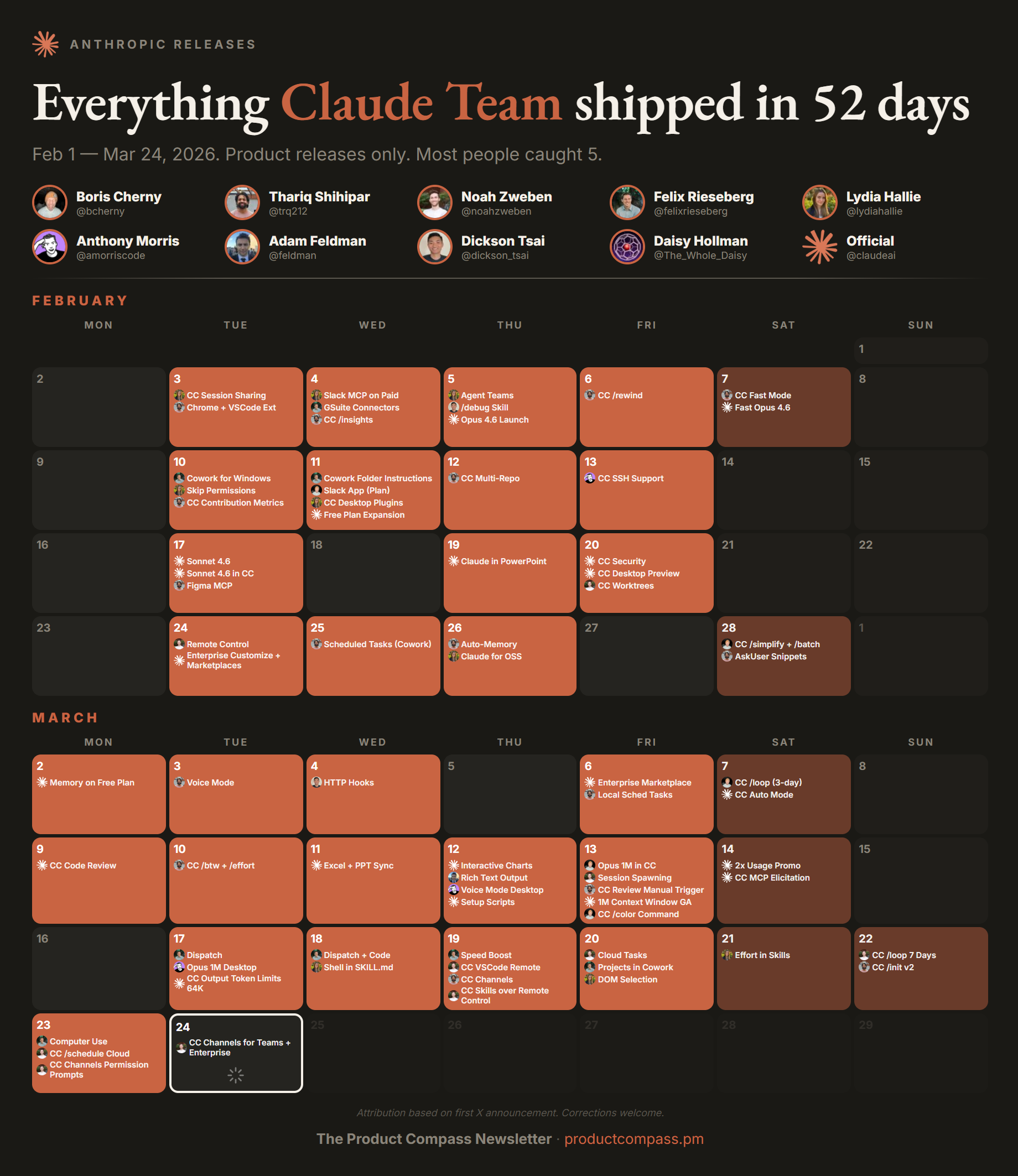
So here’s the question worth sitting with: if the old rules are dead, what replaces them?
The Rulebook That Got Us Here
For decades, building a technology company followed a recognizable script.
You found a market gap. You raised money. You hired engineers. You built a product over 12 to 18 months. You launched. You iterated based on feedback. You scaled. If things went well, you raised more, hired more, built more.
The whole system was calibrated for a world where change was fast, but predictable. You could forecast quarters. You could define a two-year roadmap and actually execute against it. Competitive advantages were durable enough to defend: your data moat, your distribution, your engineering team, your brand.
Y Combinator’s early doctrine, Paul Graham’s essays, the Lean Startup methodology, Blitzscaling… all of it assumed that the competitive landscape, while intense, moved at a pace you could plan around.
That assumption held for a long time. It doesn’t anymore.
A Pattern We’ve Seen Before
If you zoom out, this moment starts to feel familiar.
When James Watt patented the improved steam engine in 1769, it took nearly 60 years before railways connected British cities. The first factories appeared in the 1780s. Labor laws didn’t catch up until the 1830s. An entire generation was born, lived, and died inside just the first act of the Industrial Revolution.
The engine didn’t just make factories faster. It moved populations. Manchester went from a town of 25,000 to a city of 300,000 in under a century. New social classes formed. The concept of a “job” as we know it, showing up to a place, doing defined work, getting paid by the hour, was invented during this period. Entire ways of living were rewritten. But it unfolded over decades. Generations. Slow enough that society could metabolize the change, even if painfully.
The businesses that thrived weren’t the ones that built the best steam engine. They were the ones that understood what steam meant: that geography was no longer a constraint on production. The cotton mills of Lancashire didn’t win because they had better machines. They won because they reorganized everything, supply chains, labor, logistics, around what steam made possible.
Then came the internet.
Information began to move at near-zero cost. But even the internet’s disruption had a tempo you could follow. Amazon was founded in 1994 and didn’t turn a consistent profit until the mid-2000s. It took Netflix a decade to pivot from DVDs to streaming. The iPhone launched in 2007, but the mobile-first economy didn’t fully mature until the mid-2010s. Twenty to thirty years of runway. Slow enough for companies to adapt. Slow enough for people to re-skill.
The winners of the internet era weren’t the ones who built the best websites. They were the ones who understood what near-zero distribution costs meant: that you could reach everyone, that the marginal cost of serving one more customer approached zero, that network effects would create winner-take-all dynamics. Amazon, Google, Facebook didn’t just use the internet. They built business models that only made sense because of the internet.
Now compare that to what leaders like Jensen Huang are pointing at when they describe AI as the “Intelligence Revolution”: a shift not in muscle or information, but in cognition itself.
GPT-3 arrived in mid-2020. By 2023, AI was writing legal briefs, generating production code, and composing music that charted. By 2025, autonomous agents were shipping features, debugging pipelines, and running customer support at scale. That’s not a 30-year arc. That’s 5 years from “interesting demo” to “reshaping industries.”
The pattern is the same. Every great technological shift creates a window where the old rules stop working and the new ones haven’t been written yet. The businesses and people who figure it out during that window are the ones who define the next era.
But the timeline has collapsed. The window is narrower than ever. And we’re standing in the middle of it right now.
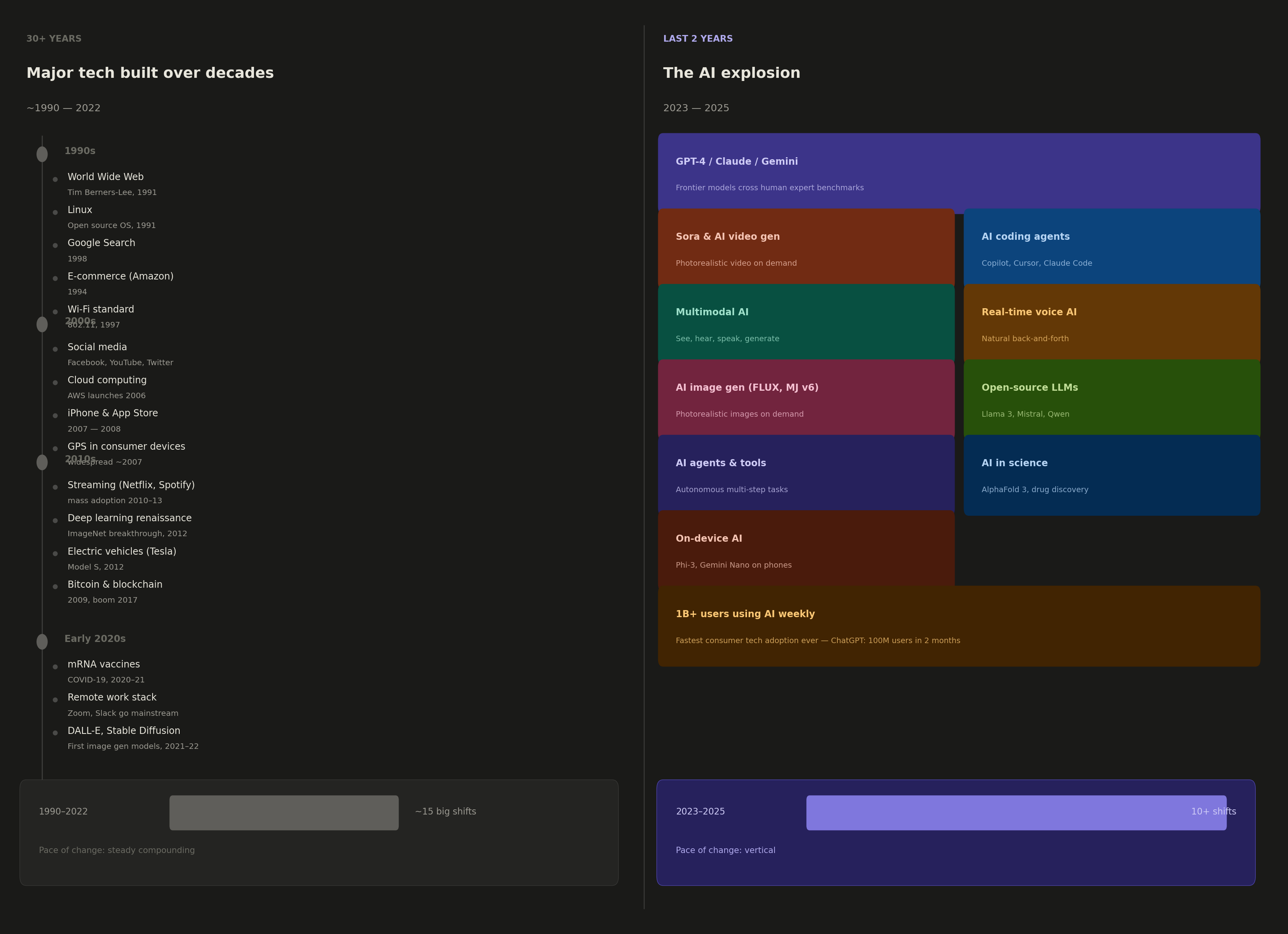
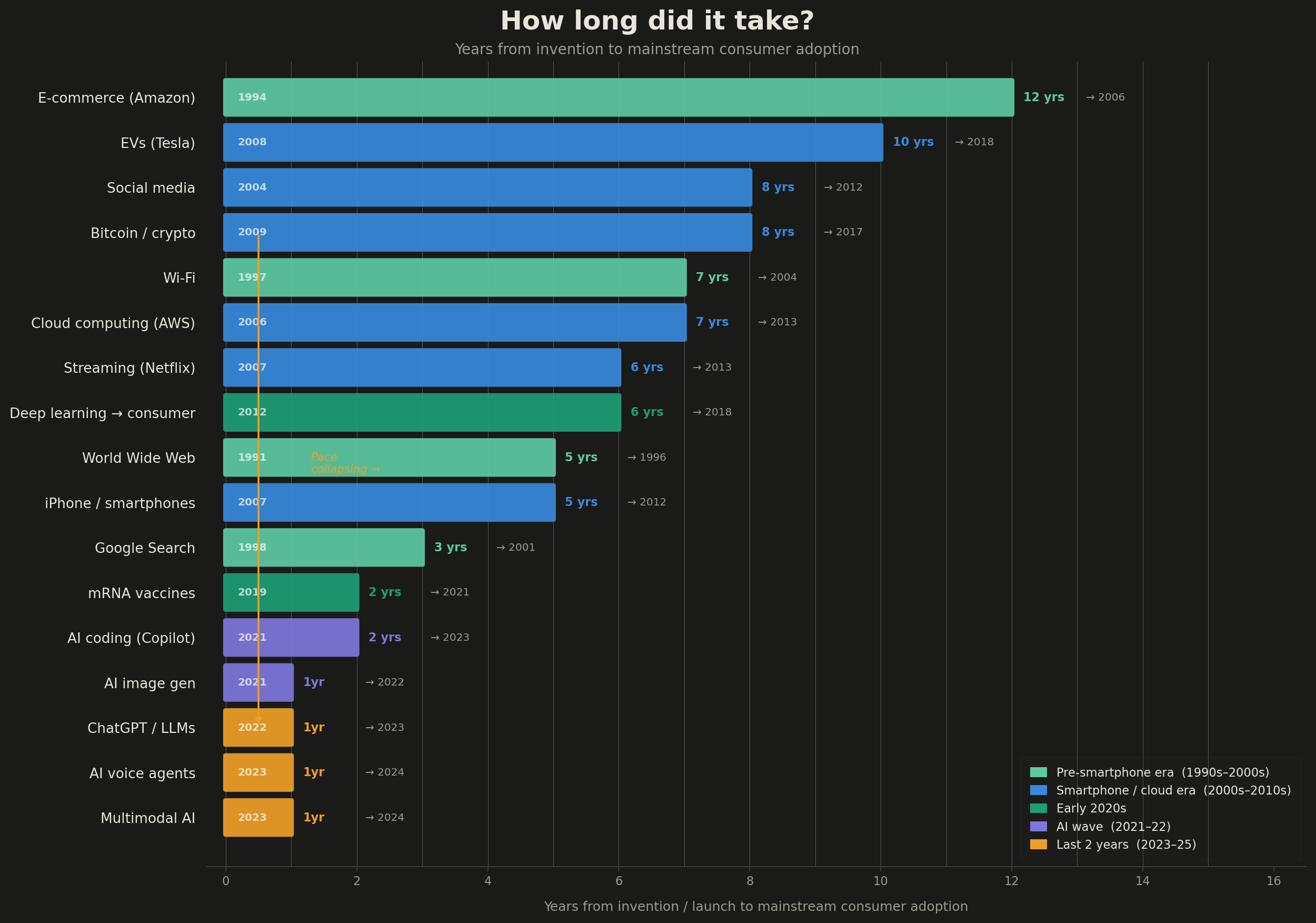
This pace of transformation is insane, if not for the fact that we’re living this life right now. It would sound like science fiction if you read it in a book ten years ago. But here we are, watching entire product categories get created and destroyed in the time it used to take to finalize a roadmap. The speed isn’t theoretical. It’s Tuesday morning. It’s the notification you just got about another launch, another model, another startup that didn’t exist last week doing what took your team a quarter. We don’t get the luxury of processing this from a distance. We’re inside the blast radius, building while the ground shifts, and somehow that’s just… the job now.
When Intelligence Became a Primitive
The real shift isn’t that software got faster. Or that products ship more frequently. Those are symptoms.
The deeper thing that happened is that intelligence itself became programmable.
For most of history, intelligence was a constraint. You could hire it, train it, organize it, but you couldn’t instantiate it on demand. Every company in history, no matter how wealthy, was bottlenecked by the number of smart people it could recruit, retain, and coordinate. That’s why org charts exist. That’s why management is a discipline. The entire machinery of corporate structure was invented to organize scarce cognition.
Now you can spin up intelligence like a container. Need legal analysis? Call an API. Need code review at 3am? It’s already running. Need to evaluate 10,000 customer support tickets for sentiment? That’s a five-minute job now, not a six-week project.
And once intelligence becomes a primitive, like storage, compute, or bandwidth before it, everything built on top of it changes.
This is the part that most businesses haven’t fully internalized. We’ve had decades of strategy built around the assumption that smart human labor is the bottleneck. Hiring plans. Training programs. Talent wars. Retention packages. Entire industries (consulting, outsourcing, recruiting) exist because human cognition was scarce and expensive.
What happens to all of that when cognition becomes abundant?
Products are no longer bundles of features. They are expressions of capability. Notion went from a note-taking app to something that drafts, summarizes, and connects your thinking. Figma added AI and the canvas started suggesting layouts. Cursor and Claude Code turned the code editor from a place where you type into something that builds alongside you, scaffolding entire features from a description, catching bugs before you do, refactoring with an understanding of your codebase.
And that raises a question (brought up by a friend just today in a discussion) that would have sounded absurd two years ago: why pay for an editor when you can pay for the agent? The editor, the IDE, the interface, those used to be the product. Now they’re becoming the shell around the thing that actually does the work. Cursor, VS Code with Copilot, Zed, they’re all positioning as agent-first environments, because they’ve recognized the shift. The value isn’t in syntax highlighting or file management anymore. It’s in the intelligence layer that understands your intent and acts on it. The editor is becoming a viewport into an agent’s workspace, not the workspace itself. As Andrej Karpathy put it, “The hottest new programming language is English,” and if that’s true, the tool you need isn’t a better text editor. It’s a better thinker.
We are moving from software that executes instructions to systems that participate in outcomes. And every business built on the old assumption, that value comes from organizing human intelligence efficiently, needs to rethink its foundations.
The Old Guard vs. The New Movement
You can already see two very different responses playing out.
The old guard is trying to absorb AI into their existing framework. They’re adding “AI features” to existing products. They’re hiring “AI teams” within traditional org structures. They’re running 18-month transformation programs. They’re treating AI like a tool to bolt on, not a force that changes the shape of the game itself.
And then there’s the new movement.
Pieter Levels runs multiple profitable products, mostly solo. Andrej Karpathy left OpenAI and started building and shipping educational tools on his own. Indie hackers are launching SaaS products in a weekend that would have taken a small team six months two years ago. The “weekend project” has become a legitimate go-to-market strategy.
What once required teams of engineers, months of development, and layers of coordination can now, in many cases, be prototyped by a single person in days. Not because problems got easier. Because leverage exploded.
A single developer with good taste and an AI assistant now has the output capacity of a small team. Not in theory. In practice. Right now. AI is acting as a force multiplier on every layer of the stack: writing code, generating designs, conducting research, even helping with strategic thinking.
Meanwhile, consider what’s happening to the incumbents. In 2022, the conventional wisdom was that AI couldn’t write reliable code. By mid-2024, Devin launched as the “first AI software engineer” and every tech company scrambled to respond. By 2025, AI-assisted coding was standard practice at most startups. Companies that spent 18 months building traditional developer tools watched their market assumptions evaporate in a quarter.
Jasper raised $125M to build an AI writing tool, then watched OpenAI launch ChatGPT and obliterate their moat in weeks. Stability AI raised hundreds of millions, then struggled as open-source alternatives and platform-native features caught up. The old thinking says your moat is your data, your distribution, your team. But when a foundation model company can replicate your core value proposition as a feature update on a Tuesday afternoon, that moat is a puddle.
Here’s the irony: it used to be that bigger companies moved slowly. That was the feature of being a startup. You found the gap between what a large incumbent knew it should build and how long it took them to actually build it. That gap was your runway. Steve Blank, the godfather of lean startup methodology, built his entire framework around this asymmetry: startups win not by outspending incumbents, but by outmaneuvering them while they’re stuck in committee. Clayton Christensen’s The Innovator’s Dilemma documented the same pattern across decades of industry: big companies see the disruption coming and still can’t move fast enough because their own success holds them hostage.
But AI has collapsed that gap from both directions. The big companies are moving faster, shipping AI features at startup speed because the cost of experimentation has plummeted, and the small companies are discovering that their nimbleness advantage has shrunk because everyone can move fast now. When Google can prototype and ship an AI feature in weeks, and a solo founder can do the same in days, the old “big company slow, startup fast” playbook stops being a reliable edge. The new gap isn’t speed of execution. It’s speed of insight, seeing what to build before anyone else does.
Capabilities change faster than planning cycles. Competitors appear overnight. Entire markets shift direction between board meetings.
The New Economics
Every great technological shift reshapes economics by making something abundant that used to be scarce. Understanding what becomes cheap is the key to understanding what becomes valuable.
Factories made physical production cheap. A shirt that once took a tailor days could be stamped out in minutes. The value shifted from the craftsman’s hands to the factory owner’s capital. The people who understood this built empires. The ones who kept thinking in terms of craftsmanship got outscaled.
The internet made distribution cheap. Sending information across the world went from expensive (fax machines, postal mail, phone calls) to effectively free. The value shifted from owning distribution channels to creating things worth distributing. The people who understood this built Google, YouTube, Spotify. The ones who kept thinking in terms of distribution gatekeeping (newspapers, record labels, broadcast networks) spent two decades in decline.
AI is making thinking cheap.
Analysis that required a team of consultants and six weeks? An afternoon. Code that needed a senior engineer? A well-written prompt. A market research report? Minutes, not months.
And when thinking becomes abundant, value shifts again. It moves away from doing the work and toward deciding what work matters. Strategy over execution. Curation over creation. Asking the right question over computing the answer.
This is economics 101 playing out in real time: when supply explodes, price drops. The supply of cognitive labor is exploding. Which means the premium falls on the things AI can’t easily replicate: taste, judgment, conviction, and the willingness to make a call when the data is ambiguous.
The founders and companies that understand this are already reorganizing around it. They’re not asking “how do we use AI to do what we already do, faster?” They’re asking “what becomes possible now that cognition is cheap?” Those are fundamentally different questions, and they lead to fundamentally different businesses.
The Recursive Engine
Perhaps the most unsettling part of this shift, and the reason it feels so different from anything before, is how recursive it is.
AI is not just helping us build products. It is helping us build better systems for building products. Which then accelerates how fast the next generation of products can be created. Which generates more data. Which makes AI better. Which…
You see where this is going.
It’s already happening concretely. AI models are being used to generate synthetic training data for the next generation of AI models. AI coding assistants are being used to write the code for better AI coding assistants. Anthropic used Claude to help build Claude. The tool is improving the toolmaker.
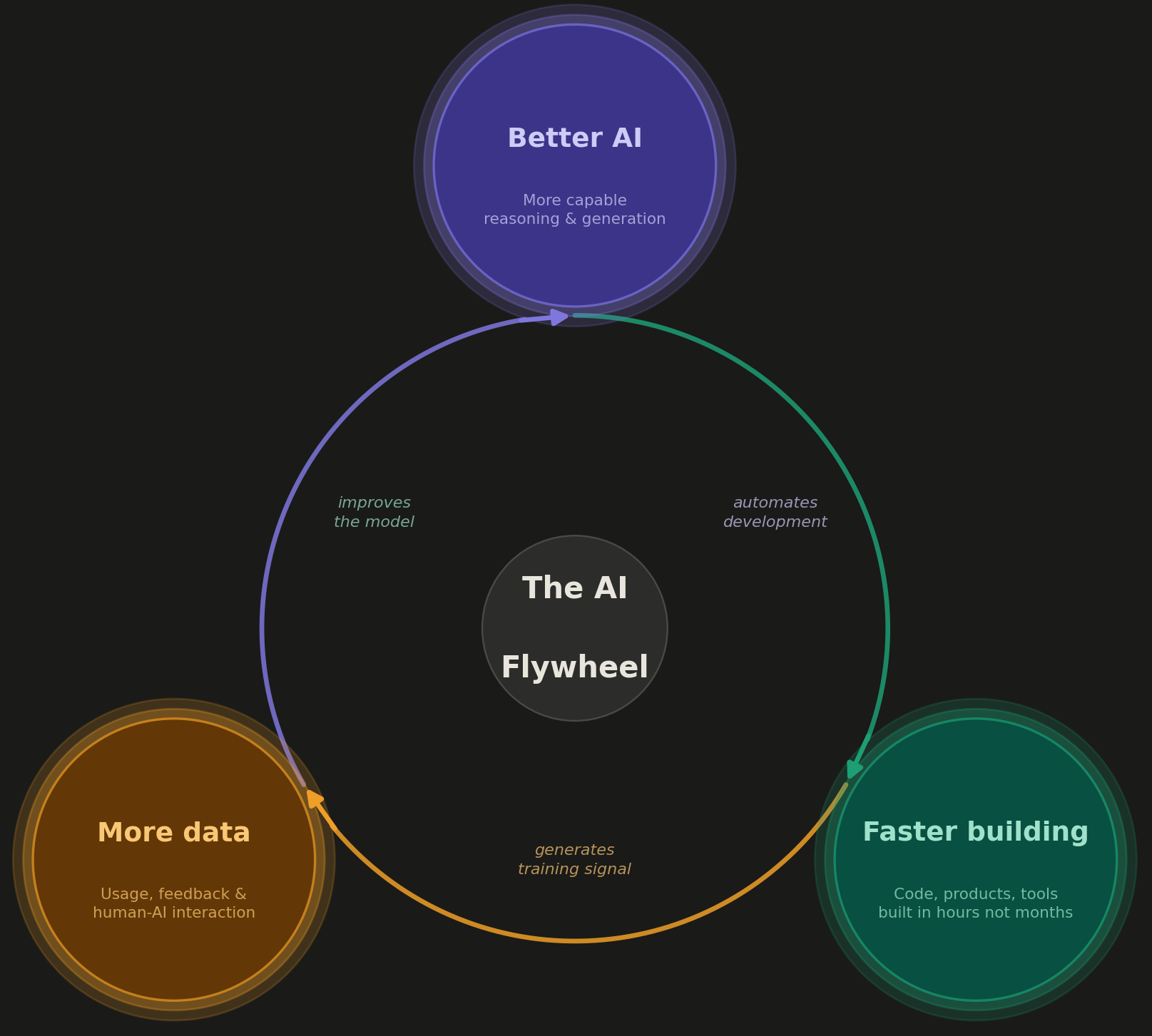
Each cycle shorter than the last. Each iteration more powerful.
Steam engines didn’t build better steam engines. The printing press didn’t write better books. The internet didn’t architect a better internet. But AI is actively involved in making AI better. That’s a fundamentally different kind of feedback loop, one that doesn’t just compound, but accelerates its own compounding.
For businesses, this means the competitive landscape isn’t just changing fast. It’s changing faster every quarter. The pace of disruption itself is accelerating. A strategy that was brilliant six months ago might be irrelevant today, not because it was wrong, but because the world it was designed for no longer exists.
Not just change, but change that gets better at changing.
Rethinking the Fundamentals
So if the old rules are dead, what does the new approach look like?
It’s still being written. But some patterns are emerging from the founders and companies that seem to be getting it right.
Think in weeks, not quarters. The planning horizon has collapsed. Companies that thrive in this environment are running rapid experiments, not executing against 18-month roadmaps. They ship something, learn from it, and adjust, often within the same week. The question isn’t “what will we build this quarter?” It’s “what can we learn this week?”
Optimize for learning velocity, not output. The old metric was shipping speed: how fast can we build and launch? The new metric is learning speed: how fast can we understand what’s changing and adapt to it? The companies that look like research labs with a revenue model are outperforming the ones that look like traditional execution machines.
Stay close to the frontier. In a world where foundation model capabilities change every few weeks, the biggest risk isn’t building the wrong thing. It’s building the right thing on yesterday’s assumptions. The founders who spend time understanding what the latest models can actually do, not what the marketing says, but what they can do in practice, have an enormous edge over those who treat the model as a black box.
Build for disposability. This sounds counterintuitive, but the best companies in this environment aren’t building cathedrals. They’re building things they’re prepared to throw away and rebuild when the underlying capabilities shift. The cost of rebuilding has dropped dramatically. The cost of being stuck with the wrong architecture hasn’t.
Leverage over headcount. The old logic said: to do more, hire more. The new logic says: to do more, multiply what you have. A small, sharp team with strong AI leverage can outpace a team ten times its size. The competitive advantage is no longer in the number of people you have, but in how much each person can do.
Judgment is the moat. When execution is cheap, the differentiator is knowing what to execute on. Taste. Strategy. The ability to read the landscape and make a call. The premium isn’t on building anymore. It’s on deciding what to build.
Getting Ahead of the Curve
Every generation believes it is living through unprecedented change. Most of them are wrong.
This time feels different. And I know, that’s exactly what someone living through any era would say. But consider the structural argument: every previous revolution amplified something external to cognition. Muscles. Movement. Communication. The thing doing the thinking about the revolution, the human mind, remained unchanged. It was always the constant in the equation.
For the first time, the variable is the mind.
The Industrial Revolution gave us machines that amplified our bodies. The internet gave us systems that amplified our communication. AI is giving us something far more powerful: systems that amplify our minds. And once the thing that drives progress is itself being accelerated, the pace doesn’t just increase. It escapes.
Getting ahead of the curve doesn’t mean predicting the future. Nobody can do that right now, and anyone who claims otherwise is selling something. It means building the capacity to respond faster than everyone else.
Arie de Geus, who studied corporate longevity at Shell, wrote that “the ability to learn faster than your competitors may be the only sustainable competitive advantage.” He wrote that in 1988. It’s never been more true than right now.
The founders who win won’t be the ones who made the best prediction about where AI is heading. They’ll be the ones who built organizations, products, and habits of mind that can absorb whatever comes next without breaking.
Because when everything else is moving (the models, the tools, the platforms, the expectations, the economics), the only way to win is to move with it.
And honestly? That’s the exciting part. We’re not watching this revolution from the outside. We’re building inside it. Every day. The tools are better than yesterday. The possibilities are wider than last week. And the thing we ship tomorrow will be built on capabilities that don’t exist yet today.
Software without pause. Building without pause.
That’s not a warning. That’s an invitation.